Choosing Your TTRPG Dice Systems
A Key Feature of Your Game
You’re a DM. You don’t just stare at the beautiful cover of a rulebook; you see a world. We’re fascinated by the dragons, the knights, and the atmosphere. But the engine that runs that world—the dice—is the most important choice you’ll make. Yes, TTRPG dice systems are that important!
Why? Because the dice system dictates the flow of the game. It determines the style of combat, the frequency of encounters, and ultimately, how often you get to slam your 3D printed miniatures onto the table.
Let’s stop thinking about dice systems as theory. Let’s start thinking about them as a tactical choice for the visual epic you want to run.
The D20 System (For High-Drama, High-Volume Battles)
The D20 is the most famous RPG die, thanks to games like Dungeons & Dragons and shows like Critical Role.
But forget the old complaints about “math.” The real reason to use a D20 is for the drama. The D20 is “swingy.” The massive variance between rolling a 1 (a critical fail) and a 20 (a critical success) creates high-stakes, unpredictable, and memorable moments.
This system, with its focus on hit points, armor class, and structured rounds, is a miniature painter’s dream.
When to Choose It: Choose a D20 system when you want combat to be a big part of the experience. With structured turns, armor classes, and hit points, these games work really well with battle maps and miniatures.
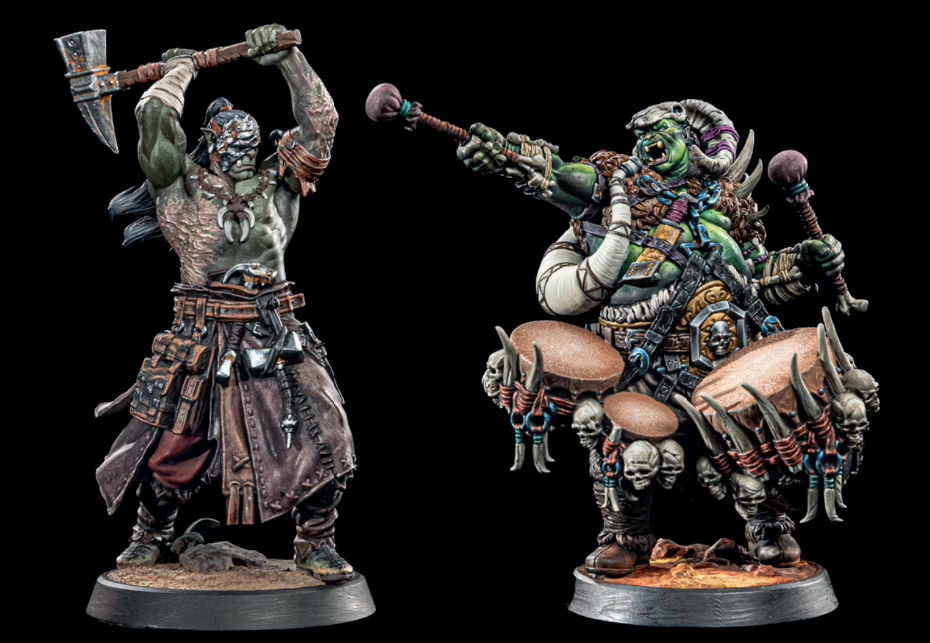
How to Use Your Minis: This is the system for your battle map. It’s your excuse to print hordes. You’re not just printing one orc; you’re printing the entire warband. You’re printing dungeon terrain, scatter, and everything else that makes a D&D-style battle a true visual feast.
The D10 System (For Deep Narrative & Key Characters)
This is the engine for narrative-heavy games like Vampire: The Masquerade and the World of Darkness series. These systems are famous for using a “dice pool”—you roll a number of D10s equal to your skill, looking for successes.
This is the engine for narrative-heavy games like Vampire: The Masquerade and the World of Darkness series. These games use “dice pools,” where you roll several D10s and look for successes. They tend to focus more on character drama, politics, and storytelling, though they still include mechanics for action and combat when things get messy.
But this doesn’t mean your printer gathers dust. In fact, it makes your minis more important.
When to Choose It: Choose a D10 system when you care more about the “why” of a conflict than the “how” of a sword swing.
How to Use Your Minis: In a narrative-heavy game, you don’t need a horde. You need a villain. This is where Loot Studios‘ high-detail character sculpts shine. You use a single, perfectly printed miniature to represent the key antagonist or a central PC. That physical, tangible object grounds the roleplaying and gives the drama a visual anchor.

The D6 System (For Accessible & Adaptable Worlds)
The D6 is the most common die on the planet, and several RPGs build their mechanics around pools of six-sided dice. One classic example is the D6 System used in the original Star Wars RPG, where players roll multiple dice based on their skills. Systems like this are usually easy to pick up and very flexible, which makes them great for groups that like to experiment or build their own worlds.
When to Choose It: Choose a D6 system when you’re a homebrewer. You want a “rules-light” engine that lets you build your own world and bolt-on your own mechanics without getting in the way.
How to Use Your Minis: Because these systems are sandboxes, your miniatures are the “kit” you use to build your custom world. You can grab sci-fi minis from one bundle and fantasy monsters from another, and the D6 system is simple enough to handle both with a few custom rules.
No Dice, No Problem (For Total Narrative Immersion)
Then, you have the “weird ones.” Systems that use Jenga towers (like Dread) or custom playing cards (like Castle Falkenstein).
These systems replace dice with different mechanics, like a Jenga tower (in Dread) or a deck of cards (in Castle Falkenstein). Instead of rolling for success, tension builds through the physical mechanic or the players’ choices. The result is often a more intense, story-driven experience where every action feels risky.
When to Choose It: When you want to run a one-shot where every player is on the edge of their seat, and the story is everything.
How to Use Your Minis: Here, your printed models are everything but game pieces. They are props. You use a single, terrifying miniature to represent the monster chasing the players. You use 3D-printed terrain to set the scene. In a game with no rules, the physical and visual elements are the only things that ground your players in the world.

Your Engine, Your World
No matter if you choose D20 for epic battles or D10 for personal drama, Loot Studios helps you achieve Total Narrative Fidelity.
Your dice system is the engine, but your miniatures are the chassis, the paint job, and the roaring sound that makes the story real. Our themed monthly bundles ensure that every creature, hero, and terrain piece is designed in a cohesive style, so your entire world looks consistent, right down to the last printed miniature.
Loot Studios can help you paint highly detailed minis, statues, and props. Choose your favorite bundle from our previous releases or sign up for Fantasy or Sci-Fi to receive a new bundle every month. You can also check out some tips on our YouTube Channel.

JP Lima is a writer, editor, TTRPG translator and overall fantasy and sci-fi enthusiast. He has been creating fantasy worlds for more time than he would like other people to know and has contributed to Brazilian magazines like Tempos Fantásticos, Mafagafo, Faísca and more. His favorite games with minis are tactical battle titles like Mice and Mystics and he loves gory, creepy and spooky figures.