Exploring RPG Races: Elves
Poets, Artisans, and Skilled Adventurers

Elves are known for their elegance, pointy ears, and uncanny beauty. But those traits alone don’t explain why they’re one of the most popular races in D&D and fantasy games. So what really makes elves stand out?
Some players would define elves as a better version of humans. Faster, stronger, wiser, and in a sense, even more pure. There’s an innocence to them that makes elves exceptionally captivating. It might be thanks to their fey ancestry or their connection with nature. Regardless, there’s certainly something magical and tricksy about them that other races may never match.
Here’s an overview of the most common elves in D&D and what players should expect when roleplaying them.
What is an Elf?
They are creatures that live approximately 700 years, at least in D&D. That’s far more than what a human is capable of. For that reason, they tend to do everything at their own pace. They do not rush to accomplish things, nor are they so tempted by common desires. Their longevity gives them a unique perspective of the world and a bigger understanding of its events. But that doesn’t mean elves are unfocused or won’t seek what they want with fervor. They’re great artisans and teachers with an affinity for magic. They enjoy art, music, nature, and all that is beautiful, making them more likely to pursue classes like minstrels or mages. Albeit elves can do wonders with swords and bows as well. If an elf minstrel sounded like something interesting, why not check this post about the bard class?

Playing an elf usually means your character will have a natural edge in Dexterity. That makes them great with agile weapons like bows and rapiers and helps with skills that rely on quick reflexes, such as stealth or acrobatics. They’re great at perception, seeing well in dark or dimly lit environments. Moreover, their fey ancestry gives them an advantage against being charmed and makes them immune to sleep by magic sources.
In fact, elves in D&D don’t sleep like other races. Instead, they enter a meditative state called a Trance for about four hours. During that time, they gain the same benefit other characters get from a full night’s rest, which makes elves excellent night watchers during an adventure. The elf is a great race to be ever vigilant and take care of others while they rest, or just spend the extra hours preparing themselves for the next day.
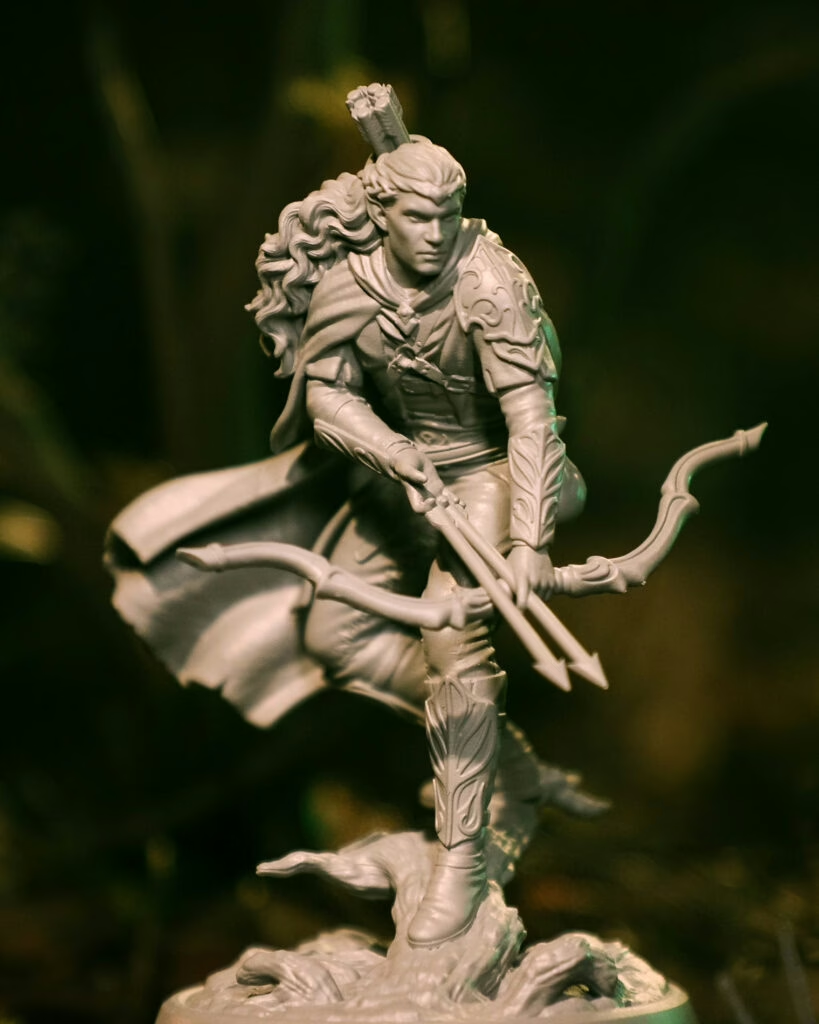
High Elves
High elves are magical creatures by nature, having an inborn talent for magic and growing up knowing its basics. There are three types of high elves: the gray elves of Greyhawk, the Silvanesti of Dragonlance, and the sun elves of the Forgotten Realms. The first one is far more reclusive and has a superiority complex, while the other two are usually more friendly and easier to find among other races.
As a high elf, the character has a bonus on intelligence, proficiency with swords and bows, and gets to choose a cantrip from the wizard spell list.
Wood Elves
As the name implies, wood elves are the ones most connected with nature and tend to live in forests. Most of them distrust outsiders or any non-elves, while a few do not. Living deep in the wilderness for generations tends to make them cautious around outsiders. And for that, people may also call them “wild elves”, spotting their groups around Greyhawk, Dragonlance, the Forgotten Realms, and in Faerûn.
They have nature’s wisdom, swift feet, and an ability to hide in plain sight when they’re lightly obscured by any natural phenomena (e.g., foliage, heavy rain, and snow).

Dark Elves
Also known as Drow, the dark elves live in the Underdark, and oftentimes are drawn towards chaos and evil intentions. Apart from other elves, these creatures can be vicious and dangerous, being feared and known for their cruelty. It is possible to make a good-aligned Drow character; however, other races may twist their noses around them as much as with Tieflings.
Interestingly, dark elves have a bonus to Charisma. In D&D, that doesn’t mean they’re friendly—it reflects their strong presence, confidence, and ability to influence others, whether through charm, intimidation, or sheer authority. They can also use rapiers and crossbows, have an affinity for magic, and can perfectly see in the dark. It is rare for a Drow to walk out of the Underdark, and they receive a penalty during combat for being in the sunlight.
Loot Studios can help you tell your story through highly detailed miniatures. Choose your favorite bundle from our previous releases or sign up for Fantasy or Sci-Fi to receive at least one new bundle every month. You can also check out some tips on our YouTube Channel.